
Mindful of the strategic importance of the petrochemical sector, the Industry Ministry says it will prioritize the development of three large, integrated petrochemical clusters in East and West Java, and Kalimantan.
These areas have hosted a number of major petrochemical plants since the mid-1990s.
"Our focus will be on expanding the upstream sector to secure supplies to downstream industries," Benny Wahyudi, the ministry's director general of agro, forestry and chemical industries, said Wednesday.
"We aim to develop each cluster as an integrated industrial zone where all the necessary support industries will also be present," he said.
The development of the upstream industry has slowed in recent years, with many planned expansion projects delayed because of the economic crisis. Slower growth in the upstream sector has, in turn, led to supply shortages in downstream industries, such as plastics and synthetic fiber producers.
While the local annual demand for ethylene -- a major raw material in plastic production -- stands at 1.3 million tons, the nation's sole ethylene producer, PT Chandra Asri Petrochemical Center, only has the capacity to supply 520,000 tons.
Petrochemical firms forecast that domestic demand for their products is set to grow by at least 10 percent annually.
With a population of 220 million, Indonesia represents a lucrative market for downstream petrochemical products, including polymers and fibers.
The government also says that a delayed aromatic products project in Tuban, East Java, is set to restart. The company, PT Trans Pasific Petrochemical Indotama, will commence operations in June 2006 and produce up to 1.06 million tons of aromatic products, such as paraxylene, benzene, toluene, orthoxylene, per annum.
In addition, it will also produce up to 1.06 million tons per annum of light naphtha, an important raw material for ethylene.
The development of the project, which is owned by Tuban Petrochemical Pte., Japan's Nissho Iwai and Itochu Corp and Tirtamas Majutama, was put on the back burner in 1998 as a result of the economic crisis. The Japan Bank for International Cooperation has provided financial support of US$400 million for the restart of the project.
Elsewhere, Indonesian Plastics Producers Association (Inaplast) chairman Didik Suwondo said the East Kalimantan petrochemical cluster should be developed as a natural gas-based production center for ethylene.
Didik explained that the price of gas-based ethylene would be 30 percent cheaper than that made from light naphtha.
"If we could develop more gas-based ethylene crackers, the downstream industries would benefit from more competitive prices," he said.
Source:
The Jakarta Post, Jakarta
Wednesday, February 08, 2006


Law Must Be Enforced in Settling Debtors Problems
Jakarta - The government has to look into the legal aspects in handling debtors of Bank Indonesia (BI)`s non-performing liquidity credits (BLBI), former chief the State Audit Board (BPK), Satrio B. Joedono said here on Wednesday."The question is whether the money or the law is important. For me, the law is important," Joedono said referring to reports that four debtors had plans to return the non-performing credits to the government.Reports quoted the finance minister as saying earlier that there were four BLBI debtors who wanted to return the money to the government.
The finance minister said she would discuss with the chief economic minister and the police chief the legal aspect that could be imposed on settling the debtors problem. Joedono said BLBI debtors had been given a chance to settle their debts through the Master of Settlement and Acquisition Agreement (MSAA).With the MSAA settlement, the debtors agreed to return the money but they failed to do so, he said.With the MSAA mechanism, debtors who had signed the agreement were given the `release and discharge` facility, whereby debtors would be freed from legal findings if they returned all amount of the credits they had received from BI, the central bank.
Earlier on Monday, three debtors came to the state palace to meet President Yudhoyono. The three were Lukman Astanto, Ulung Bursa and James Januar who respectively owed the government Rp615 billion, Rp190 billion and Rp123 billion.According to National Police chief Gen. Sutanto, they came to the state palace to follow the steps of Bank Bira`s commissioner Atang Latief who has earlier expressed readiness to return the BLBI funds to the government.Latief has been in hiding in Singapore along with many other debtors.
The government provided BLBI funds totaling Rp144.5 trillion from August 1998 to early 1999 to assist 48 ailing private banks. However, in May 1999, a Supreme Audit Agency report revealed that 95 percent of the troubled banks had misappropriated the funds.Based on reports, the Police Chief said, the debtors actually wanted to return their debts through the Indonesian Bank Restructuring Agency (IBRA) which was already liquidated.
"They wanted to return their debts, but don`t know to whom. So they issued a statement on their readiness to return their debts. In the absence of an institution to handle their debts, the settlement of their debts became protracted. Now they are able to solve their case," he said.Police Chief Gen Sutanto said on Tuesday that debtors who have surrendered themselves may not have to undergo a legal process, because according to law enforcers there was no indication they had violated the law although they had yet to secure a document stating they had paid their debts (SKL)."Their past and present status are not classified as having violated the law," Sutanto
Source:
ANTARA News
Malaysian Company to Invest in Furniture in Indonesia
Jakarta - A Malaysian company, Bandar Development Berhard, would invest in furniture industry in Indonesia, said Indonesian Agriculture Minister Anton Apriantono here Wednesday.
Minister Apriantono and Industry Minister Fahmi Idris accompanied President Susilo Bambang Yudhoyono when receiving Bandar Development Berhard Chairman Dato Mohammad Muis and its share holder Dato Seri Akbar Khan at the presidential palace here Wednesday.
The minister encouraged the Malaysian company to invest in the furniture industry. However, the company has not yet given the amount of money to be invested in Indonesia. The talks with the President were not in detail, said the agriculture minister.
Source:
ANTARA News
Indonesian Ulema Council Asks Muslims to Accept Danish Media's Apology
Jakarta - The Indonesian Ulemas (Muslim Leader) Council MUI said here Wednesday that the Muslims must accept apology of Jyllands-Posten which first published the caricatures of Prophet Muhammad last year.
MUI, however, also asked the West, which always praises the freedom of press, no to violate religious norms and to respect everything which is considered sacred by religions.
"It is the obligation of the Muslims to accept the apology of the Danish media, the Danish ambassador to Indonesia, and the Danish Government, said Vice Chairman of MUI Din Syamsuddin following a meeting of religious leaders, the media and Indonesian Foreign Affairs Minister Hassan Wirajuda at the foreign affairs ministry s office.
Din, who is concurrently general chairman of Muhammadiyah, the country s second largest Muslim organization, said Islam teaches its followers noble deeds such as accepting apology and to be forgiving.
Jyllands-Posten and the Danish Government have expressed their regrets about the publication of the caricatures, following a series of demonstrations throughout the world, which some had ended violently.
Din asked the Muslims, especially those in Indonesia, not to be trapped in violence and anarchy in responding the blasphemy of Prophet Muhammad by Jyllands Posten, which has apologized for the publication of the caricatures.
I think they have already gotten the message of the demonstrations so far. If it is considered insufficient, the messages should be presented through effective channels, he said.
He said the reactions of the Muslim were normal, but it must not be violent which is forbidden in Islam and could damage the image of Islam, especially Indonesia, which has the world s largest Muslim population.
Din urged the Western media and countries to try to understand Islam in order to prevent a clash of civilization between Islam and the West.
Because if a similar incident will repeat in the future, and they do not understand Islam, I think it would promote radicalism in the Islamic world, including in Indonesia and it would be potential to cause a clash of civilization between Islam and the West. Of course we must avoid this, he said.
Danish newspaper Morgennavisen Jyllands Posten first published the caricatures in September 2005, and later picked up by a dozen publications across Europe.
Indonesian President Susilo Bambang Yudhoyono said recently the Indonesian government condemned the publication of caricatures of the Prophet Muhammad and he could understand the public`s strong protest against the publication.
"But as religious people, we should accept the apology conveyed by both the Danish government through its ambassador in Jakarta and the editorial staff of the newspaper," President Yudhoyono said.
The embassy of Denmark in Jakarta has informed the Indonesian foreign affairs ministry of its plan to temporarily close the office, while the Danish honorary consulate in Surabaya was closed indefinitely starting on Tuesday, following a series of demonstrations in a number of cities throughout Indonesia.
Source
ANTARA News
Police Intensifies Security Precaution for Foreign Consulates
Surabaya- Police have intensified security precautions at European and US consulates following widespread demonstrations over the publication of cartoons depicting Prophet Muhammad in a Danish newspaper which were later published in several other papers in Europe, a police spokesman said.
"The police personnel reinforcement is aimed at anticipating further demontrastions and at training newly recruited police personnel," Surabaya Police Chief Snr Commr Anang Iskandar said on the sidelines of security precautions during a demonstration of Hizbuttahrir Indonesia in front of the US consulate here on Wednesday.
He said further that as many as 900 police officers were dispatched to secure the US, German and Dutch consulates at Jalan dr Soetomo and Jl dr Wahidin here.
Earlier 400 to 500 police personnel were sent to secure the area and another 200 to secure the Danish honorary consulate at jalan Sambar.
"The force will be evaluated in accordance with the development of the situation," he added.
Police also set up a police line about 100 meters from the office buildings
Source:
ANTARA News
Marubeni boosts stake in Indonesia's Astra group company
Kyodo News International (Tokyo) -- Marubeni Corp. said Wednesday it has boosted its stake in PT Surya Artha Nusantara Finance, a construction machinery financing firm of Indonesia's PT Astra International Tbk group, to 40 percent from 4.9 percent for 1 billion yen.
Expecting rapid growth in demand for construction machinery in Indonesia, the Japanese trading house said it aims to expand its financing business by strengthening its bond with the Astra group, which possess a wide retail network in the country.
Surya Artha issued new shares solely to Marubeni earlier this month for the stake hike. The Astra group holds the remaining 60 percent stake in the Jakarta-based company.
Marubeni said it has been engaged in exports of construction machinery by Japan's Komatsu Ltd. to the Astra group amid active infrastructure building in Indonesia.
Source:
Kyodo News International (Tokyo)
February 08, 2006
Freeport-McMoRan Copper & Gold Inc reports 4Q and 2005 results
CHEMICAL BUSINESS NEWSBASE - COMPANY REPORTS - CBNB
Freeport-McMoRan Copper & Gold Inc reported a net income of $463.2 M in 4Q ended Dec 2005 (net income of $212.5 M in 4Q ended Dec 2004). For year ended Dec 2005 net income of $934.6 M (net income of $156.8 M for year ended Dec 2004). PT Freeport Indonesia's (PT-FI), FCX's Indonesian mining unit, share of 4Q 2005 sales was a record 468.4 M pounds of copper and 1.1 M ounces of gold (419.2 M pounds of copper and 618,000 ounces of gold in 4Q 2004). PT-FI's share of 2005 sales totalled 1.46 bn pounds of copper and a record 2.8 M ounces of gold, (1 bn pounds of copper and 1.44 M ounces of gold for 2004). PT-FI's share of estimated recoverable reserves as of 31 Dec 2005 totalled 40.3 bn pounds of copper and 43.9 M ounces of gold. Mill throughput, which varies depending on ore types being processed, averaged 236,900 tons/day of ore in 4Q 2005 (229,800 tons of ore in 4Q 2004). Production from PT-FI's Deep Ore Zone (DOZ) underground mine averaged 41,800 tons/day of ore per day in 4Q 2005, representing 18% of mill throughput. PT-FI's share of annual sales in 2006 is expected to about 1.3 bn pounds of copper and 1.7 M ounces of gold, compared with previous estimates of 1.4 bn pounds of copper and 1.9 M ounces of gold, with the shortfall expected to be substantially recovered in 2007. The following tables are included: summary financial table of Freeport-McMoRan Copper & Gold Inc; share of sales of copper and gold; unit net cash (credits) costs; reserve additions, exploration and mine development activities for copper, gold and silver; selected operating data; consolidated statements of income (unaudited); consolidated statements of cash flows (unaudited); product revenues and production costs; cathode cash unit; consolidated financial statements; consolidated provision for income taxes; business segments; and condensed consolidated balance sheets data (unaudited) as of 31 Dec 2004 and 2005.
Sources:
Elsevier Engineering Information
Financial Times Information Limited
Asia Intelligence Wire
Ex-Smart exec joins Salim rival; PLDT's legal mess
MANILA STANDARD--The telecom executive who virtually created and made Smart Communications Inc. the premier mobile phone company in the Philippines is now in Indonesia. Anastacio "Boy" R. Martirez, former head of personal communications and mobile services division of Smart, has joined Indonesia's Sinar Mas Group, a company owned by the powerful Wijaya family.
The grapevine said Sinar Mas offered Martirez, popularly known in Smart as ARM, a $10 million package to head Mobile-8, an upstart mobile phone firm bought by the Wijaya family from PT Bimantara Citra, formerly owned and controlled by ex-president Suharto's son, Bambang Trihatmodjo. Sinar Mas offered the job to ARM long before he was fired in late November when he thought of wresting the Smart presidency from Napoleon "Polly" Nazareno.
The grapevine said the Sinar Mas offer was one key factor that emboldened ARM to openly challenge Polly and vie for the latter's post. ARM's plans at that time were not kept secret from key executives of Smart, including Polly and Manuel "Manny" Pangilinan, chairman of PLDT and popularly known as MVP.
It will be recalled that Polly and ARM, had differences in management style that was adversely effecting the programs and operations of the company. Polly, Smart's chief executive officer, gave instructions to ARM to implement certain marketing programs but ARM saw things differently and did not heed his chief's order. To make the story short, MVP realized that ARM had become more of a liability than an asset to the group and was left with no choice but to let go of the executive, one of his favorites in the company.
Indonesia connections
ARM may have lost the battle with Polly but he came out richer following a "golden handshake fee" of $4.5 million (P245 million) from Smart. ARM, in addition, had thought he had nothing to lose in his war with Polly because of the $10 million offer from Sinar Mas. He was also offered by MVP the top plum in Del Monte Pacific, which was eyed by the First Pacific group before it eventually lost to the tandem of San Miguel Corp. and Joselito "Butch" Campos.
The Sinar Mas job, meanwhile, has pitted ARM against his former boss, the Salim family, who owns the First Pacific group that, in turn, owns a quarter of Philippine Long Distance Telephone Co. (PLDT), Smart's parent company. Sinar Mas was once the second largest business group in Indonesia. It is involved in almost all areas of finance, from insurance and securities to company finance and compete directly with the interests of the Salim family.
Mobile-8 is 70.52 percent controlled by Simar Mas after acquiring it from publicly listed PT Bimantara Citra. The rest of the shares are divided among Bimantara subsidiary PT Centralindo Panca Sakti, with 9.54 percent, Asialink (8.5 percent), and a consortium of Qualcomm Inc. and Samsung Electronics of South Korea.
Dire implications
The Supreme Court (SC) decision declaring as "ill-gotten" a large block of PLDT shares owned by the late Don Ramon Cojuangco may have serious implications on all the common stocks of the telecom giant. Legal experts argued that if the SC rules with finality that those shares are indeed ill-gotten, the very PLDT shares which First Pacific currently holds could also be questioned.
"They could also be interpreted as part of the ill-gotten wealth of the Marcoses. The reason is that those contested shares and the PLDT shares currently held by First Pacific belongs to the same tree. These are the same shares, which the late businessman Ramon Cojuangco had acquired from American company GTE," a legal expert said.
"Who can stop a person, or interested party, to ask the court to declare relief that the PLDT shares of First Pacific are also tainted and part of the ill-gotten wealth of the Marcoses?"
The grapevine said certain interested parties and their lawyers are now planning this course of action.
Source:
Manila Standard.
February 08, 2006
Thai sugar premiums rose anticipated buying from Indonesia
NEW YORK, Feb 08, 2006 (Dow Jones Commodities News via Comtex) --The March world raw sugar contract was up 11 points at 18.28 cents a pound on the New York Board of Trade midway through Wednesday's session, erasing a 27-point drop to Tuesday's low.
Thai sugar premiums rose in the week ended Tuesday as sellers anticipated buying from Indonesia, Philippines and Taiwan. "Fresh demand is brewing and we are in a position to export," a Bangkok-based trader said. Buyers in Asia are returning to the market after the Lunar New Year holidays. On Tuesday, Thai raws for March-May shipment were offered at 0.80 cent/lb., free-on-board Bangkok, over the Nybot March contract, versus 0.75 cent a week ago.
Indonesian's Bulog is shopping for white sugar this week, traders said. Trading Corp. of Pakistan is looking for 50,000 tons of refined sugar on Feb. 16 for mid-March shipment. The Philippines needs to buy.
Funds exited March longs in the early slide but trade houses bought the March/May spread, providing support. March has stayed in Tuesday's range so far.
"We're occupied with the March roll and there's some positioning ahead of Friday's March options expiration," a desk trader here said. Funds are selling the March/May spread while trade houses buy the switch in their rollovers, he observed.
March is trading at a premium to May after the Mar/May spread settled at "even" on Tuesday. March has retreated from Friday's 24-year high of 19.73c.
Nybot March world sugar options expire Friday, and the March futures exit the board on Feb. 28.
Nybot March finds support at 17.90, 17.88, 17.85, 17.82 and 17.80 cents and faces resistance at 18.35-18.36, 18.38, 18.40, 18.42 and 18.45 cents. The March domestic (No. 14) contract expires Friday.
Source:
Susan Buchanan,
Dow Jones Newswires
Toyota predicting a shortfall mainly in Japan and Indonesia
THE BIRMINGHAM POST--Although Toyota lowered its sales volume forecast for the business year by 80,000 units to 7.95 million vehicles, predicting a shortfall mainly in Japan and Indonesia. Toyota has posted a 14 per cent rise in third quarter profits as overseas markets raced ahead and a weaker yen boosted the value of earnings.
Brisk demand for cars such as the Prius hybrid and cost-cutting efforts helped the company absorb extra spending on new and expanded manufacturing facilities around the world after three straight quarters of profit decline.
The investment has included a pounds 50 million spend to boost production at its Burnaston factory near Derby to 285,000 Avensis and Corolla vehicles per year. With key new models such as the Camry and Lexus LS saloons and the Tundra pickup truck to be rolled out in the lucrative US market soon, analysts expect further gains for Toyota as it closes the gap with General Motors, the world's top seller of cars.
Senior managing director Takeshi Suzuki said: "With these results, we managed to expand our profits through the first three quarters from the year-earlier period despite the big investment outlays to meet ballooning vehicle demand.
"The weaker yen helped, but all in all I think it was a commendable performance." Toyota, which the market values at pounds 106 billion - more than DaimlerChrysler, Honda, and Nissan Motor combined - had an operating profit of pounds 2.32 billion for October-December. Group revenues grew 15 per cent to pounds 25.9 billion as global sales volume rose 7.7 per cent to 1.98 million units.
Last year Toyota recorded its 14th consecutive year of growth in the UK with 138,536 cars and commercial vehicles sold here. Corolla (24,199), Verso (9,570) and Prius (3,749) all recorded their highest ever annual sales while Toyota's best selling model was the Yaris (33,981). Toyota's domestic rivals, Nissan and Honda, also reported better third-quarter earnings last week, helped by the yen's fall against the dollar, euro and other currencies.
Tough competition from Asian brands has sent core automotive operations of GM and Ford reeling under losses, forcing America's top two auto makers to call for massive job cuts and plant closures.
"The operating environment is good for Toyota right now," said Yoshihisa Okamo-to, a senior vice president at Fuji Investment Management, adding that the market focus would shift to the outlook for next business year.
"Toyota has been investing in production capacity and I think we can expect them to post solid growth. I think Toyota's stock will rise."
Toyota does not provide group-based profit forecasts but repeated its prediction that it would beat last year's record levels.
A consensus forecast of 22 brokerages puts Toyota's group operating profit at pounds 8.5 billion for the year ending in March, up 4.7 per cent from the last business year.
Heavy capital spending is expected to keep profit growth in check compared with revenue expansion.
Mr Suzuki was coy about spending plans for next year, saying that while it would not rise or fall significantly, high commodity prices meant investments could end up being more expensive.
For calendar 2006, Toyota now plans to make 9.06 million vehicles, up ten per cent from 2005, as the firm bids to replace General Motors as the world's largest automaker.
Source:
THE BIRMINGHAM POST
Protracted uncertainty leaves ports high and dry
Indonesia looks set to remain dependent on port facilities in neighboring countries for the foreseeable future, with a lack of certainty in the legal and planning spheres having resulted in the halting of a number of major port development projects.
The government's promises to local and overseas investors during the Infrastructure Summit a year ago to immediately address the uncertainty problem in the investment arena to date remain nothing more than promises.
Projects involving the construction of a new port at Bojonegara, Banten, the expansion of Tanjung Priok Port in Jakarta and the expansion of Tanjung Perak Port in East Java were all introduced to investors during the summit, but to date remain firmly stuck on the drawing board.
Poor infrastructure planning coupled with disputes between the central and local governments over who gets to run the ports are currently the main causes of uncertainty in the port sector. Ironically, funding no longer seems to be a problem.
Poor planning is reflected by the recent instruction from the Transportation Ministry to put the first phase of the Bojonegara port project on hold due, despite the fact that a number of investors had expressed interest.
Transportation Minister Hatta Radjasa told The Jakarta Post in a recent interview that the project had to be halted by the government as a number of potential investors had made their involvement in the project contingent on a government guarantee that no similar port projects would be undertaken in the vicinity, except in the case of insufficient port capacity in the future.
The would-be investors included Singapore's PSA, Hong Kong's Hutchison Port Holdings, and Australia's P&O Ports. "The investors were concerned that the existence of similar ports in the vicinity would reduce the utilization of Bojonegara, and thus the feasibility of their investments. The government will need to study this problem further," said Hatta.
Although initial construction at Bojonegara was started in 2003, the ministry nevertheless permitted the Jakarta administration and state port operator PT Pelindo II to commence construction of the Jakarta New Port (JNP), part of the Tanjung Priok expansion program, in 2004.
The JNP is located about 150 kilometers east of Bojonegara. Meanwhile, about 50 kilometers west of Bojonegara, there are two other ports capable of providing international services -- Cigading Port, operated by state-owned steel producer PT Krakatau Steel, and Ciwandan Port, managed by Pelindo II.
"The aim of Bojonegara Port is to alleviate congestion at Tanjung Priok Port, and to provide direct-call services. The government wants to ensure that once completed, part of the containers from Jakarta will go to this port," said Hatta.
It remains far from clear why the Transportation Ministry did not anticipate this problem earlier, long before the project was offered to investors.
The fate of Bojonegoro Port will be decided by the Office of the Coordinating Minister for the Economy before the project is offered again during the upcoming second Infrastructure Summit in March.
The uncertainty has inflicted potential losses on Pelindo II, which is charged with operating Bojonegara Port, of around Rp 170 billion (US$18.2 million) arising out of land acquisition and the construction of a 300-meter berthing facility.
Four state firms, Pelindo I, II, III and IV, have a monopoly on the management of ports handling international traffic across the country. Any investor willing to build an international port must work together with the relevant Pelindo company.
Investment in the port sector is also suffering as a result of uncertainty arising out of disputes between the central and local administrations, with each claiming the right to manage ports.
The local administrations base their arguments on the Autonomy Law, which appears to run contrary to other legislation that gives the Pelindo companies the sole right to manage international ports in Indonesia.
The proposed expansion of Tanjung Perak Port into Lamong Bay in the eastern part of Surabaya, which was offered to investors last year, is a prime example of such a dispute.
The expansion, which is supported by the central government and Surabaya municipality, is opposed by the East Java administration, which insists that the new port be built on Madura island for environmental reasons.
There are no signs that the dispute will be resolved any time soon. As a result, the project remains firmly stalled.
Indonesia, Southeast Asia's largest economy, has long dreamt of having its own international-class seaports -- large enough to function as hub ports -- unlike the present situation in which most of the products shipped in or out of the nation have to be pooled first in much larger ports in Singapore and Malaysia.
This situation has not only made shipping costs more expensive, but has also made the country heavily dependent on foreign vessels, leaving the underdeveloped local shipping industry to stagnate.
The Transportation Ministry has estimated that 80 percent of the country's exports and imports go via Singapore or Malaysia, causing potential losses of more than US$2 billion per annum to local businesses.
The government says it is aware of the problem, but no concrete measures have been taken to date.
Indonesian National Shipowners Association (INSA) chairman Oentoro Surya said the business community was concerned about the protracted uncertainty surrounding port development, which hampered local shipping companies from expanding.
"What makes local players reluctant to go global is partly the fact that there are no ports that are able to handle direct shipments. The country's exporters are therefore at the mercy of port operators in Singapore and Malaysia," said Oentoro.
Source:
Rendi Akhmad Witular,
The Jakarta Post, Jakarta
Government may review Freeport mining contract
The government will review the mining contract of PT Freeport Indonesia if the giant gold miner is found to have polluted the environment in Papua, according to Energy and Mineral Resources Minister Purnomo Yusgiantoro.
Purnomo said Tuesday an interdepartmental team would conduct a follow-up investigation based on a recent report from the Office of the State Minister for the Environment that the local unit of the world's biggest gold and copper miner, Freeport-McMoran Copper & Gold Inc., was responsible for serious pollution in and around its mining concession. Following the investigation, the team would make recommendations for further action.
"Before we review Freeport's mining contract, we will have to see whether it has actually violated any environmental regulations. Representatives of our inspectorate general will be members of the team ...," he told reporters.
He acknowledged that should the allegations of pollution be borne out, Freeport would be at risk of having its mining contract terminated.
Purnomo explained that mining companies in Indonesia would no longer be given special treatment to such an extent that outside ministries (other than the Energy and Mineral Resources Ministry) were prevented from investigating possible irregularities or abuses.
"The mining sector is now open to all ministries. For example, taxation problems will be handled by the Ministry of Finance while environmental issues will be addressed by the State Minister for the Environment. Our ministry will no longer involve itself in such issues," he said.
The Office of the State Minister for the Environment earlier said that Freeport had broken the country's environmental legislation by illegally dumping hazardous waste in the Otomina River, thereby endangering biodiversity and public health along the length of the river.
The Otomina River flows close by the Freeport mine in resource-rich Papua province. The ministry is currently investigating the pollution allegations against Freeport to obtain conclusive evidence before taking legal action.
Freeport, however, has denied the allegations, saying it has never violated any environmental regulations during its more than three decades of operations in the province.
Source:
Rendi Akhmad Witular,
The Jakarta Post, Jakarta
Astro Is Ready To Roll Across Asia
Step one for the Malaysian satellite-TV company: A push into Indonesia. Next stop, India?
For years, Astro PLC seemed to be overreaching with the name of its headquarters. After all, why should a monopoly satellite-TV company serving only Malaysia call its offices the "All Asia Broadcast Center"? Now, Astro is finally catching up to its ambitions. This spring the company will expand its TV operations outside its home turf, offering its own channels and foreign rebroadcasts such as CNN and Al-Jazeera to viewers in Indonesia. "Having built a strong domestic base, we are now beginning to roll out regionally," says David Butorac, Astro's chief operating officer.
The move comes just in time. In October, nine-year-old Astro's stranglehold on the Malaysian pay-TV market was broken when cable operator MiTV Corp. started broadcasting 41 channels in Kuala Lumpur. Soon, another cable rival called Fine TV plans to join the fray.
Astro, of course, has a big head start and will be tough to unseat. Part of billionaire Ananda Krishnan's empire -- which includes Malaysia's top cellular phone operator, Maxis Communications -- Astro has 1.8 million subscribers, or about a third of Malaysian households, up from 1 million customers in 2002. It also dominates radio, with nine stations that control 70% of Malaysia's radio advertising revenues. That adds up to big profits. Astro will post income of $59 million this year on sales of $561 million, and earnings of $91 million on revenues of $691 million in 2006, Macquarie Securities says.
Much of that will be spent in Indonesia.
In March, Astro sealed a joint venture with Jakarta-based Lippo Group to launch its satellite service there. Lippo owns Kabelvision, which offers cable in Jakarta and a handful of other cities. Together, the companies hope they can get much greater penetration with satellite, aiming to serve some 3 million households -- nearly 10% of all homes with TVs -- by 2010.
Indonesia, though, may be a battle.
The country is Asia's third most populous after China and India, but just 1.4% of Indonesian households with televisions subscribe to pay-TV, vs. 32% in China and 58% in India. That's great for Astro, of course, but it also makes the market appealing to rivals. The world's biggest pay-TV operator, Rupert Murdoch's News Corp., recently bought a 20% stake in Indonesia's Cakrawala Andalas, which has satellite and terrestrial TV operations.
Astro does have advantages over even a deep-pocketed rival such as News Corp. First, there's language: Indonesians and Malaysians mainly speak Bahasa, which should help Astro develop new shows more cheaply. Astro has programming tie-ups with Indian studios, which make shows for both Indian TV and Astro's Malaysian channels.
Content suppliers such as Walt Disney Co., Home Box Office, and others that have worked with Astro in Malaysia are ready to follow the company into Indonesia and elsewhere in the region. And Astro has a joint venture with Hong Kong's Yes TV to operate two 24-hour soccer channels with rights to games from top European clubs. "Astro is the most successful Asian pay-TV operator outside Japan and Korea," says Vivek Couto of Media Partners Asia, a Hong Kong consultancy.
After Indonesia, Astro wants to go deeper into the region. Although he won't say what countries might be next, Butorac expects non-Malaysian pay-TV operations to account for 40% of revenues within five years. "Our strategy is to be a regional cross-media player," he says.
Although he faces regulatory hurdles today -- few countries in Asia currently allow foreign-owned radio or pay-TV operations -- Butorac expects that to change in coming years. If it does, the company might just grow into its headquarters.
Source:
Assif Shameen,
BusinessWeek
AirAsia flew 97,484 people to Indonesia in December
KUALA LUMPUR: AirAsia Bhd, South-East Asia's biggest low-fare airline, said it carried 35% more passengers in December compared with a year earlier, as more people chose to fly for leisure and business in the region.
December traffic rose to 812,492, bolstered by a sevenfold growth in the number of people flying to Indonesia, where AirAsia began serving in December 2004, according to an e-mailed statement by the company. AirAsia said it flew 97,484 people to Indonesia in December.
The number of passengers flying to Malaysia rose to 514,161 in December, 19% higher than a year earlier, while the number of people flying to Thailand rose 27% to 200,847 in December from a year earlier, AirAsia said.
Demand for travel helped lift profit in the fiscal first quarter ended Sept 30, by 13% to RM11.8mil from a year earlier. Sales grew 50% to RM186.3mil. It expects to exceed annual profit in 2005.
AirAsia serves 57 destinations in Malaysia and six other Asian countries.
Source:
Bloomberg
February 8, 2006
Bank account for maids
KUALA LUMPUR: More than 300,000 employers of domestic maids will soon have to open bank accounts in their maids' names and pay the salary into the accounts monthly.
With this, employers will not be allowed to hold the maids' salaries.
“There have been a lot of complaints by international agencies that employers were not paying foreign maids their wages,” Human Resources Minister Datuk Fong Chan Onn told The Star.
Source:
M.Krishnamoorthy & Siow Yuen Ching
The Star Malaysia
February 8, 2006
With this, employers will not be allowed to hold the maids' salaries.
“There have been a lot of complaints by international agencies that employers were not paying foreign maids their wages,” Human Resources Minister Datuk Fong Chan Onn told The Star.
It will cover all employers of foreign and local maids, he added.
Dr Fong said the rationale for the inclusion of the clause were:
- PROTECTION on payment of wages to maids;
- ELIMINATE instances of employers keeping their wages; and
- PREVENT cases of non-payment of wages.
“By making a clear-cut policy on this, domestic maids will be protected and they cannot claim that their wages were not paid,” he said.
The opening of bank accounts will be mandatory in the amendments proposed to the Employment Act, 1955, due to be tabled in Parliament next month.
The proposed clause under Section 57A, Wages of Domestic Servant, states:
“It will be mandatory for employers of a domestic servant to pay the wages of domestic servants into the domestic servant’s bank account.”
Currently, there is no stipulation in the Act requiring employers to pay their domestic servants' wages into a bank account. The Malaysian Foreign Workers Association president Datuk Raja Zulkepley Dahlan said some illegal agencies did not pay maids and this move would prevent such cases.
Malaysian Trades Union Congress (MTUC) secretary general G. Rajasekaran supported the proposed change and said that it was aimed at safeguarding the domestic maids.
“The bank account will ensure that the maid receives the money,” he added.
Bank officer Tan Chow Sin, 51, said he had been doing this since the time he first had a maid and was comfortable with the arrangement.
“She will feel secure as she will be able to see her hard-earned money safe in her account, while my wife and I can sleep peacefully knowing that she won't run away,” he said.
Professional services manager P. Seran who has employed maids for several years said that with the banks now open for five days, it would be cumbersome for working employers to open the account, and withdraw and transfer the cash.
“The current arrangement of us paying her cash is a convenient method and acceptable to the maid. It will be too much of a hassle for us to keep going to the bank to deposit and withdraw each time she wanted money from her savings.”
Another employer P. Guna Sundari said that they had opened a separate account under her husband’s name, and at the end of every month the maid is shown the savings account book when it is updated.
In Penang, Home Affairs Ministry secretary-general Tan Sri Aseh Che Mat said Malaysia and Indonesia have reached consensus on the terms of the long-delayed Memorandum of Understanding (MoU) on employment of maids from the republic.
The MoU, to be signed by May, will be the first official agreement between the two countries on Indonesian domestic workers' recruitment in Malaysia.
He said representatives from both countries have drawn up a proposed MoU during a two-day technical committee meeting in Penang which started on Monday.
Source:
M.Krishnamoorthy & Siow Yuen Ching
The Star Malaysia
February 8, 2006
Tucan secures loan deal for RI project
JAKARTA: PT Tucan Pumpco Services Indonesia has signed a US$4.5 million loan agreement with Overseas Private Investment Corporation to finance the company's oil well cementing and stimulation services across the country.
OPIC is a U.S. government agency promoting U.S. private investment in emerging markets.
"Our experience with challenging well environments in Venezuela will be relevant for many of the Indonesian fields, where we see operators beginning to undertake higher pressure, more acidic and deeper drilling programs," Francisco J. Gali Jr, president director of PT Tucan, said in a statement.
PT Tucan has already signed its first cementing contract for a project in Sumatra
Source:
The Jakarta Post
February 08, 2006
‘Garden of Eden’ found
SYDNEY: Australian and other scientists have found a 'Lost World' in a remote Indonesian mountain jungle, home to exotic new species of birds, butterflies, frogs and plants as well as mammals unafraid of humans despite being hunted to near extinction elsewhere.
“It’s as close to the Garden of Eden as you’re going to find on Earth,” said Bruce Beehler, co-leader of the US, Indonesian and Australian expedition to part of the cloud-shrouded Foja mountains in the province of Papua that covers the western half of New Guinea.
Indigenous peoples living near the Foja range, which rises to 2,200m, said they had never ventured into the trackless area of 3,000 sq km.
The team of 25 scientists took helicopters to boggy clearings in the pristine zone.
“We just scratched the surface,” Beehler said. “Anyone who goes there will come back with a mystery.”
Two long-beaked echidnas, the egg-laying species similar to those found in Australia, simply allowed scientists to pick them up and bring them back to their camp to be studied, he said.
The expedition found a new type of honeyeater bird with a bright orange patch on its face, known only to local people and the first new bird species documented on the island in over 60 years.
They also found more than 20 new species of frogs, four new species of butterflies and plants, including five new palms.
And they took the first photographs of Berlepsch’s six-wired bird of paradise, which appears in 19th century collections but whose home had previously been unknown.
The bird is named after six fine feathers about 10cm long on the head of the male which can be raised and shaken in courtship displays.
The expedition also took the first photographs of a golden-fronted bowerbird in front of a bower made of sticks, while he was hanging up blue forest berries to attract females.
It found a rare tree kangaroo, previously unsighted in Indonesia.
Beehler said the naturalists reckoned that there was likely to be a new species of kangaroo living in higher altitudes.
Papua, the scene of a decades-long separatist rebellion that has left an estimated 100,000 people dead, is one of Indonesia’s most remote provinces, geographically and politically, and access by foreigners is tightly restricted.
Sources:
Reuters & AP
Wednesday February 8, 2006
BI keeps key interest rate unchanged
Upbeat that inflation will eventually subside over the course of the year, the central bank has left its key interest rate unchanged at 12.75 percent in a move that should help avert a further slowdown in economic growth.
"Macroeconomic stability has been maintained, relatively speaking, with inflation under control, the rupiah gaining strength, and the banking sector still performing quite satisfactorily -- all of which are as we expected," the Bank Indonesia Board of Governors said in a statement after their monthly meeting to assess the economy Tuesday.
The central bank kept its BI rate unchanged last month, hinting at the beginning of the end of its monetary tightening, which began last July, after consumer prices fell by 0.04 percent in December.
Following December's deflation, monthly inflation of 1.36 percent in January, however, stoked fears that the central bank might tighten its monetary policy once again by further raising the key interest rate. BI Governor Burhanuddin Abdullah had also said that the central bank still regarded inflationary pressures as high, despite the rupiah's recent strengthening against the U.S. dollar.
Analysts had, nevertheless, expected BI to continue tempering its monetary policy, given that inflation was being brought under control with the current interest rate. The government is expecting full-year inflation of 8 percent, with BI allowing a plus-minus range of 1 percent.
Mandiri Sekuritas chief economist Kahlil Rowter, who had forecast that BI would leave its rate unchanged, said the decision was also due to the fact that rupiah-denominated assets were now more attractive than dollar-denominated ones.
Given the current BI rate, the U.S. Federal Reserve rate of 4.5 percent, and their respective yields, Kahlil said the real interest rate differential between the rupiah and dollar assets was between 0.6 and 1 percent.
"This range is within BI's comfort zone and enough to attract investors. And with the rupiah recently gaining against the greenback, there is no need for BI to raise its rate," he said.
Despite continuing moderation in its monetary policy, BI has warned of various external and internal factors that could disrupt macroeconomic stability and economic growth over the coming months.
"Inflation has been contained, but there are still risks to the economy. Externally, there exists the risk of volatility in the prices of oil and other commodities, as well as a possible slowdown in the global economy," Burhanuddin told reporters after the board's meeting.
Meanwhile, adverse factors at home included the poor investment climate and defective taxation system, both of which were hampering growth in the real sector.
Source:
Urip Hudiono, The Jakarta Post, Jakarta
February 08, 2006
Tuesday, February 07, 2006
Allianz syariah products for Indonesia
FRANKFURT: Allianz AG said its Indonesian unit is launching syariah-compliant insurance products, responding to “growing requests” from its customers and banking partners.
The insurer said customers could now buy life insurance, fire and motor vehicle policies that would be syariah-compliant.
Allianz's share of the Indonesian market is below 3%. The company said it predicted that the booming syariah market would help improve this penetration. Syariah banking in Indonesia grew by 88.6% in 2005. –
Source:
AFX-Asia
Tuesday February 7, 2006
Telkomsel, Indosat, Excelcom win 3G licenses; PT Telekomunikasi Indonesia and PT Bakrie Telecom failed
The Indonesian government has awarded PT Indonesian Satellite, PT Excelcomindo Pratama and unlisted PT Telekomunikasi Selular, or Telkomsel, licenses to operate third-generation, or 3G networks, State Minister for Information and Communication Sofyan Djalil said on Wednesday.
Third-generation cellular technology offers subscribers high-speed data transmission services such as video streaming, fast downloads, live traffic updates and even home surveillance services.
The tender for the 3G network was attended by fivetelecommunication companies. PT Telekomunikasi Indonesia and PT Bakrie Telecom failed to win the tender.
Based on "the willingness to pay" requirement, Sofyan said both Telkom and Bakrie Telecom failed to meet the requirement."The minimum bid was set at Rp 100 billion (US$10.87 million)," he added.
Indosat offered to pay Rp 160 billion to get the license, while Telkomsel bid Rp 218 billion and Excelcom tendered Rp 188 billion.
The usage of the license is for ten years, Sofyan added.
Indonesia previously granted 3G licenses to cellular phone operator PT Natrindo Telepon Seluler, which is 51 percent owned by Malaysia's biggest cellphone company Maxis Communications Bhd.and PT Cyber Access, 60 percent owned by HutchinsonTelecommunications International Ltd.
However, both Natrindo, which received its 3G license in 2003, and Cyber Access, which obtained a license in 2004, have yet to offer 3G services to their subscribers, as the necessary network infrastructure has still to be put in place.
Analysts said the delay in implementing the 3G network is mostly due to the huge funding required to develop the business.
Source:
Dow Jones
February 08, 2006
Indonesia invites North Korean leader to Jakarta
JAKARTA (AP): President Susilo Bambang Yodhoyono has invited North Korean leader Kim Jong Il to Jakarta for talks on how to reduce tension with South Korea, presidential spokesman Dino Patti Djalal said on Wednesday.Kim Jong Il, who rarely travels abroad, has said he "welcomed" the offer and also invited Yudhoyono to North Korea, Dino said. He said possible dates for both trips were still being discussed.
The invitation was passed to North Korea by Indonesia's special envoy to the Koreas during a trip to both countries last weekend, he added said.
It was unclear how Kim, who generally shuns planes, would travel to the Indonesian archipelago. During one of his rare trips to Russia, he went by train all the way to Moscow.
The offer is the latest effort by Indonesia to mediate in the dispute.
In January, South Korean Defense Minister Yoon Kwang-ung said during a visit to Jakarta that he would like to meet his North Korean counterpart on the resort island of Bali to discuss ways to reduce tensions between the two countries.
Defense ministers of the two rival Koreas last met in September 2000 on the South Korean resort island of Jeju after first-ever inter-Korean talks in June that year. The two nations remain technically at war because the 1950-1953 Korean War ended in a cease-fire rather than a peace treaty.
Ties have warmed significantly since a meeting of North and South Korean leaders in 2000, but tensions persist over the North's nuclear ambitions.
Indonesia and North Korea have historical ties.The country's first president, Soekarno, was a close friend of North Korean leader Kim Jong Il's late father, Kim Il Sung. Soekarno's daughter, Megawati Soekarnoputri, was Indonesian president between 2001 and 2004 and has kept up a friendship with Kim Jong Il.
Source:
The Jakarta Post
February 08, 2006
Indosat may invest Rp 2 trillion in 3G
JAKARTA: PT Indosat, currently participating in a tender for a 3G frequency license, may invest more than Rp 2 trillion (US$215 million) -- mostly for infrastructure to support the technology -- should it win the tender.
This figure does not form part of the company's capital spending of $670 million in 2006, Indosat president Hasnul Suhaimi said Monday.
The company expects the investment, should it materialize, to begin bringing in returns over the next three years.
Indosat, PT Telkomsel, PT Bakrie Telecom, PT Excelcomindo and PT Telkom are competing for three blocks of 3G frequency licenses that the government is currently offering through a tender -- the winner of which will be announced Feb. 14.
The government has set an initial bid price of Rp 200 billion per block, with each block containing two 5 MHz frequency bands. Indosat has submitted a bid for one block
Source:
The Jakarta Post
February 07, 2006
Indonesia seeks US$2.5b in loans from CGI to over budget deficit
Despite recent calls to reduce the country's reliance on foreign debt, the government is still hoping to secure at least US$2.5 billion in loans from creditors in the Consultative Group on Indonesia to help cover this year's budget deficit.
The loans, said Finance Minister Sri Mulyani Indrawati during a hearing Monday with the House of Representatives' finance commission, would form part of a total of $3.55 billion in external loans that the government was eying for this year.
"We are expected $1 billion in program loans from the World Bank, the Asian Development Bank and Japan this year. There will also be project loans totaling $2.55 billion, with $1.53 billion of these coming from the CGI," she said.
Other project loans include $915 million from non-CGI lenders, mostly in the form of export credits, and $100 million in undisbursed pledges made in connection with last year's Aceh tsunami disaster.
Japan, the World Bank and the ADB are the three largest creditors grouped in the CGI, which is scheduled to hold its annual meeting sometime in March. The group pledged $3.4 billion in loans and grants last year, besides $1.7 billion in grants and interest-free loans for Aceh.
While the government plans to raise Rp 35.1 trillion (some $3.5 billion) from external sources to help finance this year's budget deficit, projected at Rp 22.4 trillion, or 0.7 percent of gross domestic product, it also plans to raise Rp 50.9 trillion from domestic sources, including through privatizations and bond sales. However, of the total borrowings, up to Rp 63.5 trillion will go toward paying installments on existing debts.
Sri Mulyani said Indonesia's total outstanding foreign debt as of last year amounted to $61.04 billion, but pointed out that the country's debt-to-GDP ratio had declined to 22.7 percent from 42.2 percent in 2000.
Most of the debts are in the form of bilateral loans and are denominated in Japanese yen, which entails certain risks. On the other hand, the interest rates on the loans are more stable.
"The government will maintain prudent debt management, borrowing only when needed at the lowest possible rate and for the longest possible term, and when the projects are ready to proceed," she said.
"We will also carefully guard the exchange rate between the rupiah and the yen, as well as against the dollar, to reduce potential risks vis-a-vis our debts."
Source:
Urip Hudiono, The Jakarta Post, Jakarta
February 07, 2006
Trade figures reveal problems faced by local exporters
Despite record 2005 export earnings, a closer look at the trade statistics suggests the country's manufacturers are having a tough time competing overseas, particularly against more efficient manufacturers from other countries in the region.
The Central Statistics Agency (BPS) reported last week that the country's export earnings jumped by 19.53 percent from the 2004 figure to a record US$85.6 billion.
But according to a more detailed BPS report obtained by The Jakarta Post on Monday, volume-wise, exports only grew by 10.09 percent last year.
Dantes Simbolon, the head of the BPS export statistics subdirectorate, explained that soaring global commodity prices had contributed greatly to the at-first-sight impressive performance.
By volume, oil and gas exports were down 8.6 percent, while non-oil and gas exports, including minerals but excluding coal and sand, increased by 13.1 percent, the BPS figures show.
What is worrying is that in the manufacturing sector, exports of textiles and garments, furniture and electronics have dropped in volume terms. These sectors are among the largest contributors to export revenue and job creation.
Textile and garment exports, for example, only amounted to 1.03 million tons as of October 2005, while exports of these goods reached 1.63 million tons the previous year.
The last two months of 2005 would not have added much to the figures as the year-end is always slower for export-oriented businesses.
Left struggling by China's booming textile and garment industry, Indonesian exports of these products failed to achieve the targeted figure of $7.9 billion, and grew by less than 5 percent last year.
The industry has been plagued by overlapping problems of increasing energy costs, smuggling and aging machinery.
The Indonesian Textile Association reported that 77 export-oriented firms had ceased operating because of increasing energy costs and eroding markets due to a slump in competitiveness.
Meanwhile, exports of wood products and furniture dropped to 3.2 million tons last year as compared to 5.3 million tons in 2004.
The Indonesian Furniture Producers Association placed the blame for the decline on a lack of raw materials and soaring prices for teak -- which is heavily used in the production of furniture destined for export.
Meanwhile, producers of electronic goods complain of the high import duties imposed on components, leading to a lack of price competitiveness on the export market.
This led to a decline in electronics exports to 0.5 million tons last year compared to 0.67 million tons in 2004.
Indonesian Chamber of Commerce and Industry vice chairman Rachmat Gobel said the government needed to further lower the import duties on raw materials for the electronics sector in order to restore competitiveness.
Given the myriad of complaints from the private sector, observers say it is clear the government needs to be more alert in responding to changes in the global market if it wants Indonesia to maintain its place among the ranks of the emerging economies.
Source:
The Jakarta Post, Jakarta
February 07, 2006
Cooperative BLBI bankers may be exempt from trial
The government may revert to the controversial release and discharge policy in the settlement of obligations of delinquent bankers from the Bank Indonesia Liquidity Support (BLBI) program.
The government will screen BLBI debtors to select ones who should be exempt from prosecution, with priority given to those who have been diligent in returning state assets although they fled the country before their cases were processed.
The issue was discussed Monday between President Susilo Bambang Yudhoyono and Attorney General Abdulrahman Saleh, National Police chief Gen. Sutanto, Coordinating Minister for the Economy Boediono, Finance Minister Sri Mulyani Indrawati, chief of the interdepartmental team for corruption eradication Hendarman Supandji, Corruption Eradication Commission chief Taufiequrrahman Ruki and Justice and Human Rights Minister Hamid Awaluddin.
Under the release and discharge policy, which was criticized by non-governmental organizations and corruption watchdogs, ex-bank owners deemed cooperative in settling their debts had all criminal charges dropped against them.
Finance Minister Sri Mulyani said the mechanism was still under discussion because there were no means currently available to manage returned assets from troubled bankers following the disbandment of the Indonesian Banking Restructuring Agency (IBRA).
She said the government was looking into ways to process the debtors, while maximizing resources for the return of state assets, with the main involvement of financial and legal ministries.
"The coordinating minister for the economy will coordinate this," she said.
Four of the bankers came to the presidential office with National Police deputy chief of investigators Insp. Gen. Gorries Mere and National Police director for economic crime Sr. Comr. Benny Mamoto.
National Police chief Gen. Sutanto identified only two of them as Bursa and James. One of them, according to a presidential office staff source who spoke on the condition of anonymity, was Lukman Hastanto, the son in law of debtor and commissioner of disbanded Bank Bira, Atang Latif, who was recently brought back to Indonesia from the United States.
"Three of them have obligations to the state of Rp 615 billion (US$66.13 million), Rp 190 billion and Rp 123 billion respectively. We expect more will follow in the coming weeks," Sutanto said.
They did not meet the President, he added, but came on their own initiative to seek ways to settle their obligations to the state. Sutanto said the debtors would be classified in several groups, including those whose banks experienced problems to mismanagement and irregularities, and institutions forced to seek Bank Indonesia support who then incurred problems.
"We will examine their respective cases. We have to be fair to those who are cooperative in settling their obligations," he said. Abdul Rahman Saleh said the government had lists of debtors who were classified as cooperative and noncooperative. He stressed the latter would be prosecuted.
"But of course we will not process again those who have been exempted from debt obligations by previous governments. Don't mix them up with the newer ones, because we cannot process them again as the public wants," he said.
A banker convicted in the BLBI scam -- David Nusa Wijaya of Bank Servitia -- was returned to Indonesia from the United States last month.
Source:
Tony Hotland, The Jakarta Post, Jakarta
February 07, 2006
Standard & Poors: Bank Industry Overview: Indonesia
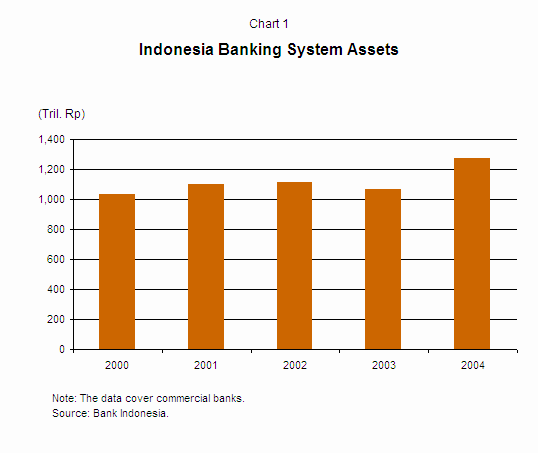

Source:
Bank Industry Overview: Indonesia
Primary Credit Analyst:
Adrian Chee, Singapore
Publication date: 17-Jan-06, 21:31:31 EST
The outlook on the Indonesian banking sector remains stable. The sector has slowly begun to rebuild its financial base since the 1997 economic crisis, and progress has accelerated in the past three years. The level of capitalization in the banking system has risen due to improving investor confidence following several completed privatization programs. The industry risk profile, nevertheless, remains high by international standards because of the high-risk operating environment, characterized by slow corporate debt restructuring, volatile exchange rates, and the need for reforms in the legal system. These factors are partially mitigated by improved political stability, a relatively more stable credit quality and earnings performance, and strengthening capitalization levels. Going forward, the Indonesian banks are expected to experience increasing pressure on their interest margins, from higher deposit costs, as well as in their quality of loan portfolio, in the current rising interest rate environment.
Positive factors
Infusion of best practices and expertise in management strategies, risk management practices, human resources, and IT systems, as a result of foreign institutional investment in major private commercial banks in Indonesia.
Structural improvement where consolidation has reduced the number of banks to around 130 in July 2005, from 208 in 1998. In addition, banks have sought to improve their operating efficiency.
Improved capitalization. The government's large-scale recapitalization program has improved the capital position of banks, which have also benefited from recovering profitability in the past few years. Nevertheless, the banks' capitalization might face renewed pressure as they restart lending to productive sectors of the economy and seek to bolster the level of provisioning for nonperforming assets (NPAs).
Improving asset quality. The banking system's regulatory gross nonperforming loan (NPL) ratio has steadily improved to 8.5% in July 2005, from 32.8% in December 1999. The trend for NPAs, which include NPLs, foreclosed properties, and some restructured loans, is estimated to improve to 15% of total loans in December 2005, from about 50% in 1999.
Negative factors
The resumption of banks' role as financial intermediaries. While the system's loan growth has been strong over the past two years, the loan to asset ratio is still relatively low, at around 40% in 2004. This was partly attributed to the lack of productive loan opportunities in the real sector, and also reflected the corporate sector's high business risks and the large amount of NPLs due for restructuring. The ratio is expected to increase as banks have continued to post strong growth in their lending portfolios in 2005.
Susceptibility of credit quality in a higher interest-rate environment. While the system has demonstrated an overall improvement after the Asian financial crisis, the sharp growth in loans in the past two to three years could strain loan quality following a time lag for NPLs, particularly as interest costs rise as a result of the rising interest rate environment.
A Brighter Day for Asia's Banks?
From Standard & Poor's Ratings Services
Regional growth seems likely to continue, despite high energy prices, and with improving risk-management standards, prospects appear
The nascent Year of the Fire Dog under the Chinese lunar calendar may just be a favorable one for the Asian banking sector. Favorable environmental and operational factors indicate that the outlook remains bright going into 2006. Nonetheless, bank management teams still need to sink their teeth into outstanding issues to prepare for unexpected shocks and the inevitable future cyclical downturn.
Still-strong (albeit slowing) regional GDP growth, improving asset quality, stable and increasingly diverse earnings, and increased management emphasis on risk controls support the banks' improved credit profiles.
RISK FACTORS.
To a certain degree, Standard & Poor's Ratings Services had factored these improvements and expectations into its upgrade on bank ratings in 2005. Outstanding issues in the banks' environment include inherent volatility of economies in which the banks operate and, in some systems, governance concerns in the commercial, political, and legal arenas. These factors imply that Asian banking systems continue to face moderately low to very high economic and industry risks. Not surprisingly, there are some dark clouds in the distance -- these take the form of weaker U.S. consumer demand, relatively high oil prices, emerging bottlenecks in some parts of China's infrastructure, and the uncertain effects of the spread of avian flu, and more importantly public fear about the disease.
Standard & Poor's outlook for the Asian banking systems for 2006 can be summarized as follows:
STREAMLINED OPERATIONS
Inflationary pressures persist, with oil prices only moderating from record highs, even as more oil bears have emerged. Global liquidity, while still ample, is tightening. Asian central banks are playing catch-up with the U.S. Federal Reserve and the pace of interest-rate hikes could quicken in 2006 ahead of a likely end in U.S. policy tightening in June.
Interest-rate increases are thus expected to affect the housing and asset prices in Asian markets, although a major downturn in most real estate markets appears unlikely. The U.S. housing market could be more severely affected by the higher Federal Reserve rate, moderating consumption and thus exports from Asia.
Corporate restructuring -- partly in response to competition from China -- across Asia has streamlined operations and increased capacity utilization as well as capital expenditures. There are also some signs of diversification away from China by U.S. and European investors. Rising interest rates have had greater impact on consumers (from higher mortgages payment) than on corporate investment plans and credit profiles in Asia due partly to strong corporate earnings. Corporate indebtedness is generally low to modest, except for Philippines and, to an extent, Indonesia.
CAPITAL INFLOWS
A more severe outbreak of Avian flu could reduce global GDP by 1% even if the situation does escalate into a pandemic, according to the World Bank. National health authorities have thus far contained the flu to a very small number of geographic locations.
The most immediate uncertainty is inflation and the use of monetary policy (including exchange-rate adjustments) to maintain price stability. Policy responses will inevitably have an impact on the quality of longer-term growth. Strong credit growth and big capital inflows in some economies can complicate monetary policy management.
Negative real rates, for instance, are still prevalent in some economies. The scenario assumes that adjustments in the financial imbalances between the U.S. and the world in terms of currency and interest rates will be gradual.
FAVORABLE FACTORS
Asian countries have largely recovered from the 1997-98 financial crisis, but are vulnerable to the above-mentioned risks. A close look at the state of Asian banking systems should provide a better assessment of their vulnerability to these risks.
Asset quality indicators have continued to improve over the past few years due to write-offs/provisions, recovery from the stock of NPAs—by way of actual recovery or sale to an asset reconstruction/management company—and better quality of incremental credit. Improved economic conditions have been an important supportive factor.
Loan loss reserves are improving. The average loan loss reserves to NPA ratio is above 40% in most Asian banking systems, except China and Taiwan. Loan loss reserves have improved only for a few banking systems, as most banks have used existing provisions to write off the loans.
ONGOING TREND
A few systems still have significant vulnerability in their credit portfolios. Of these, a few like China and Indonesia have seen their credit portfolios grow rapidly. While the growth will spread the risk and provide earning streams to help tackle past delinquencies, it will put pressure on still-evolving risk-containment systems.
In this context, corporate sector credit quality and consumer indebtedness are key risks. India and China are reasonably comfortable on this count, but the Philippines and, to an extent, Indonesia are not. Hence, continued credit growth can help accelerate the trend of improving asset quality for the Chinese, Indian and, perhaps, Indonesian banking systems. The expected slower pace of growth in 2006 would retard the improvement but is unlikely to reverse the trend.
In conclusion, asset quality indicators have vastly improved from four to five years ago. As the low-hanging fruits in the NPA pools have already been plucked, further reduction in NPA would come from resolution of the relatively more hard-core NPAs. Given structural constraints in and challenges faced by the developing economies during the growth phase, the indicators for most Asian banking systems are unlikely to match those of developed systems over the medium term. Standard & Poor's expects asset quality indicators to continue to improve for all Asian systems in 2006 but at a pace slower than in 2005.
Earnings: Stable, More Diversified
The profitability of the Asian banks, as measured by net interest income to average adjusted assets, has largely remained stable in the 2%-3% range, even through the rising interest-rate regime in 2004 and 2005.
PRESSURE ON MARGINS.
Most of the Indonesian banks rated by Standard & Poor's had higher interest margins, exceeding 5%, in 2004 due to a higher level of intermediation. Competitive forces and steeply rising policy rates in Indonesia are expected to cause the interest margin to decline to a more sustainable 3%-4% range.
Variable-rate loans form the lion's share of Asian banks' portfolio. Due to the dominance of shorter-tenure fixed-rate deposits, these liabilities are akin to variable-rate liabilities. Hence, a bank's pricing power determines the impact of rising interest rates, rather than the structure of the balance sheet per se. Except for Singapore and Hong Kong whose markets are dominated by a few big banks, most of the region's banks will experience interest-margin pressure.
To maintain profitability, banks in these competitive markets will target consumer and small to midsize business lending, fee income, and improvement in efficiency and economies of scale. Diversification of the earnings profile, including the focus on noninterest income, has continued. The outlook for growth of noninterest income is bright due to the low penetration of insurance, mutual funds and retail credit businesses, and continued recovery in most economies.
ABOVE-AVERAGE RETURNS
Banks have continued to grow their nonbanking businesses organically as well as inorganically in domestic and overseas markets in a bid to diversify their income. This process is especially visible in Indonesia and Malaysia. Some banks have, however, chosen to tie up with finance companies with good retail franchises.
Although Singapore and Hong Kong banks' interest margins are significantly lower than the 3% rate of most Asian banks, their return on average assets is better at well above 1%. This is due to a higher proportion of noninterest income, better operating efficiency, and low credit costs.
In 2006, we expect the profitability of Asian banking systems to be largely sustained at current levels. The structural improvement in the income profile due to a significant consumer loan book and increasing share of noninterest income should help these systems weather a slight economic slowdown.
Risk Management: Center Stage
The risk-management systems of Asian banks are in various stages of evolution. The Singapore and Hong Kong banks are the most sophisticated, given the developed markets they operate in. After recovering from severe credit losses during the Asian financial crisis, banks are strengthening their risk-management systems.
With the proportion of mandated lending significantly reduced, banks need to develop the capability to originate healthy loans and monitor their portfolios. Gradual improvement in prudential lending norms in line with international standards and the impending implementation of Basel II capital adequacy framework add to the urgency of establishing sound risk-management systems. While this trend is common across all emerging markets, Taiwanese, Malaysian, Indian, and Thai banks are moving further ahead than their regional peers.
In general, the risk-management systems have come a long way. While there is scope for further strengthening, existing systems should partly shield leading banks from the adverse effects of an expected economic slowdown in 2006. We also expect banks to step up the pace in strengthening their risk-management practices.
Consolidation Continues
Another trend is industry consolidation, which has been led or enabled by governments. The speed and effectiveness of consolidation have been mixed, reflecting each country's resolve in achieving its goals.
A less-fragmented banking system tends to be more robust and easier to supervise. Through consolidation, banks are able improve their competitiveness by exploiting synergies and achieving economies of scale. In general, the long-term aim is to have fewer but stronger national banks. While market pressure can also drive consolidation, most emerging Asian banking systems are dominated by government-owned banks and hence market forces alone are insufficient to spur change.
PICKING UP STEAM
While Malaysia saw a rapid and decisive first phase of consolidation and has embarked on the next phase, Taiwan, India, and Thailand still have a long way to go in this direction -- and the clock is ticking. By 2009, their banking systems will open up to foreign banks. Through mergers, domestic banks in fragmented markets like Taiwan, India, and Thailand can take advantage of synergies and economies of scale and thus become better prepared to compete in a liberalized banking environment. Only healthy and efficient domestic banks that have strong business and financial profiles will be ready to meet the competition from established global players.
In 2005, M&A activity was relatively subdued, with transactions mostly involving the acquisition of strategic stakes, rather than majority control. Even though there is little debate on the need for speedy consolidation, the pace of M&A activity in 2006 will be driven by respective governments. In our opinion, bank M&A will gather some steam in 2006 but remain slow as there is no serious visible push from governments as yet.
Source:
BusinessWeek & Standard & Poor's Ratings Services
February, 2006
Regional growth seems likely to continue, despite high energy prices, and with improving risk-management standards, prospects appear
The nascent Year of the Fire Dog under the Chinese lunar calendar may just be a favorable one for the Asian banking sector. Favorable environmental and operational factors indicate that the outlook remains bright going into 2006. Nonetheless, bank management teams still need to sink their teeth into outstanding issues to prepare for unexpected shocks and the inevitable future cyclical downturn.
Still-strong (albeit slowing) regional GDP growth, improving asset quality, stable and increasingly diverse earnings, and increased management emphasis on risk controls support the banks' improved credit profiles.
RISK FACTORS.
To a certain degree, Standard & Poor's Ratings Services had factored these improvements and expectations into its upgrade on bank ratings in 2005. Outstanding issues in the banks' environment include inherent volatility of economies in which the banks operate and, in some systems, governance concerns in the commercial, political, and legal arenas. These factors imply that Asian banking systems continue to face moderately low to very high economic and industry risks. Not surprisingly, there are some dark clouds in the distance -- these take the form of weaker U.S. consumer demand, relatively high oil prices, emerging bottlenecks in some parts of China's infrastructure, and the uncertain effects of the spread of avian flu, and more importantly public fear about the disease.
Standard & Poor's outlook for the Asian banking systems for 2006 can be summarized as follows:
- Asset-quality indicators will continue to improve for all Asian systems in 2006, but at a pace slower than in 2005. The low-hanging fruits in the nonperforming asset (NPA) pools have been plucked and further reduction in NPA would come from resolution of the relatively more hard-core NPAs.
- Profitability of Asian banking systems will be sustained largely at current levels, supported by structural improvement in the income profile.
- The strengthening of risk-management practices at Asian banks will pick up in pace.
- Merger and acquisition (M&A) activity will gather some steam in 2006 but remain slow as there is no serious visible push from governments as yet.
- GDP growth for many Asian economies is likely to remain strong in 2006, despite a slight easing from 2005. In the medium term, a slowing trend is expected. Global macroeconomic conditions, including growth, liquidity, and interest rates, are still favorable for the region's economies.
STREAMLINED OPERATIONS
Inflationary pressures persist, with oil prices only moderating from record highs, even as more oil bears have emerged. Global liquidity, while still ample, is tightening. Asian central banks are playing catch-up with the U.S. Federal Reserve and the pace of interest-rate hikes could quicken in 2006 ahead of a likely end in U.S. policy tightening in June.
Interest-rate increases are thus expected to affect the housing and asset prices in Asian markets, although a major downturn in most real estate markets appears unlikely. The U.S. housing market could be more severely affected by the higher Federal Reserve rate, moderating consumption and thus exports from Asia.
Corporate restructuring -- partly in response to competition from China -- across Asia has streamlined operations and increased capacity utilization as well as capital expenditures. There are also some signs of diversification away from China by U.S. and European investors. Rising interest rates have had greater impact on consumers (from higher mortgages payment) than on corporate investment plans and credit profiles in Asia due partly to strong corporate earnings. Corporate indebtedness is generally low to modest, except for Philippines and, to an extent, Indonesia.
CAPITAL INFLOWS
A more severe outbreak of Avian flu could reduce global GDP by 1% even if the situation does escalate into a pandemic, according to the World Bank. National health authorities have thus far contained the flu to a very small number of geographic locations.
The most immediate uncertainty is inflation and the use of monetary policy (including exchange-rate adjustments) to maintain price stability. Policy responses will inevitably have an impact on the quality of longer-term growth. Strong credit growth and big capital inflows in some economies can complicate monetary policy management.
Negative real rates, for instance, are still prevalent in some economies. The scenario assumes that adjustments in the financial imbalances between the U.S. and the world in terms of currency and interest rates will be gradual.
FAVORABLE FACTORS
Asian countries have largely recovered from the 1997-98 financial crisis, but are vulnerable to the above-mentioned risks. A close look at the state of Asian banking systems should provide a better assessment of their vulnerability to these risks.
Asset quality indicators have continued to improve over the past few years due to write-offs/provisions, recovery from the stock of NPAs—by way of actual recovery or sale to an asset reconstruction/management company—and better quality of incremental credit. Improved economic conditions have been an important supportive factor.
Loan loss reserves are improving. The average loan loss reserves to NPA ratio is above 40% in most Asian banking systems, except China and Taiwan. Loan loss reserves have improved only for a few banking systems, as most banks have used existing provisions to write off the loans.
ONGOING TREND
A few systems still have significant vulnerability in their credit portfolios. Of these, a few like China and Indonesia have seen their credit portfolios grow rapidly. While the growth will spread the risk and provide earning streams to help tackle past delinquencies, it will put pressure on still-evolving risk-containment systems.
In this context, corporate sector credit quality and consumer indebtedness are key risks. India and China are reasonably comfortable on this count, but the Philippines and, to an extent, Indonesia are not. Hence, continued credit growth can help accelerate the trend of improving asset quality for the Chinese, Indian and, perhaps, Indonesian banking systems. The expected slower pace of growth in 2006 would retard the improvement but is unlikely to reverse the trend.
In conclusion, asset quality indicators have vastly improved from four to five years ago. As the low-hanging fruits in the NPA pools have already been plucked, further reduction in NPA would come from resolution of the relatively more hard-core NPAs. Given structural constraints in and challenges faced by the developing economies during the growth phase, the indicators for most Asian banking systems are unlikely to match those of developed systems over the medium term. Standard & Poor's expects asset quality indicators to continue to improve for all Asian systems in 2006 but at a pace slower than in 2005.
Earnings: Stable, More Diversified
The profitability of the Asian banks, as measured by net interest income to average adjusted assets, has largely remained stable in the 2%-3% range, even through the rising interest-rate regime in 2004 and 2005.
PRESSURE ON MARGINS.
Most of the Indonesian banks rated by Standard & Poor's had higher interest margins, exceeding 5%, in 2004 due to a higher level of intermediation. Competitive forces and steeply rising policy rates in Indonesia are expected to cause the interest margin to decline to a more sustainable 3%-4% range.
Variable-rate loans form the lion's share of Asian banks' portfolio. Due to the dominance of shorter-tenure fixed-rate deposits, these liabilities are akin to variable-rate liabilities. Hence, a bank's pricing power determines the impact of rising interest rates, rather than the structure of the balance sheet per se. Except for Singapore and Hong Kong whose markets are dominated by a few big banks, most of the region's banks will experience interest-margin pressure.
To maintain profitability, banks in these competitive markets will target consumer and small to midsize business lending, fee income, and improvement in efficiency and economies of scale. Diversification of the earnings profile, including the focus on noninterest income, has continued. The outlook for growth of noninterest income is bright due to the low penetration of insurance, mutual funds and retail credit businesses, and continued recovery in most economies.
ABOVE-AVERAGE RETURNS
Banks have continued to grow their nonbanking businesses organically as well as inorganically in domestic and overseas markets in a bid to diversify their income. This process is especially visible in Indonesia and Malaysia. Some banks have, however, chosen to tie up with finance companies with good retail franchises.
Although Singapore and Hong Kong banks' interest margins are significantly lower than the 3% rate of most Asian banks, their return on average assets is better at well above 1%. This is due to a higher proportion of noninterest income, better operating efficiency, and low credit costs.
In 2006, we expect the profitability of Asian banking systems to be largely sustained at current levels. The structural improvement in the income profile due to a significant consumer loan book and increasing share of noninterest income should help these systems weather a slight economic slowdown.
Risk Management: Center Stage
The risk-management systems of Asian banks are in various stages of evolution. The Singapore and Hong Kong banks are the most sophisticated, given the developed markets they operate in. After recovering from severe credit losses during the Asian financial crisis, banks are strengthening their risk-management systems.
With the proportion of mandated lending significantly reduced, banks need to develop the capability to originate healthy loans and monitor their portfolios. Gradual improvement in prudential lending norms in line with international standards and the impending implementation of Basel II capital adequacy framework add to the urgency of establishing sound risk-management systems. While this trend is common across all emerging markets, Taiwanese, Malaysian, Indian, and Thai banks are moving further ahead than their regional peers.
In general, the risk-management systems have come a long way. While there is scope for further strengthening, existing systems should partly shield leading banks from the adverse effects of an expected economic slowdown in 2006. We also expect banks to step up the pace in strengthening their risk-management practices.
Consolidation Continues
Another trend is industry consolidation, which has been led or enabled by governments. The speed and effectiveness of consolidation have been mixed, reflecting each country's resolve in achieving its goals.
A less-fragmented banking system tends to be more robust and easier to supervise. Through consolidation, banks are able improve their competitiveness by exploiting synergies and achieving economies of scale. In general, the long-term aim is to have fewer but stronger national banks. While market pressure can also drive consolidation, most emerging Asian banking systems are dominated by government-owned banks and hence market forces alone are insufficient to spur change.
PICKING UP STEAM
While Malaysia saw a rapid and decisive first phase of consolidation and has embarked on the next phase, Taiwan, India, and Thailand still have a long way to go in this direction -- and the clock is ticking. By 2009, their banking systems will open up to foreign banks. Through mergers, domestic banks in fragmented markets like Taiwan, India, and Thailand can take advantage of synergies and economies of scale and thus become better prepared to compete in a liberalized banking environment. Only healthy and efficient domestic banks that have strong business and financial profiles will be ready to meet the competition from established global players.
In 2005, M&A activity was relatively subdued, with transactions mostly involving the acquisition of strategic stakes, rather than majority control. Even though there is little debate on the need for speedy consolidation, the pace of M&A activity in 2006 will be driven by respective governments. In our opinion, bank M&A will gather some steam in 2006 but remain slow as there is no serious visible push from governments as yet.
Source:
BusinessWeek & Standard & Poor's Ratings Services
February, 2006
Singaporean Jemaah Islamiyah leader detained under Internal Security Act
Jakarta: Singapore's most-wanted man, Mas Selamat Kastari, accused of plotting to crash a plane into Changi Airport, is back home under detention after his arrest and deportation by Indonesian authorities.
Singapore JI leader Mas Selamat Kastari who led the Singapore chapter of South-east Asia's Jemaah Islamiyah (JI) terrorist network, was handed over to the Singapore authorities last Friday [3 February] by their Indonesian counterparts, it was announced yesterday.
In its statement, Singapore's Home Affairs Ministry said Mas Selamat is currently being held under the Internal Security Act and investigations into his case will now proceed. It noted that he had fled Singapore in December 2001 following the crackdown on the JI network.
"He was among those who had planned retaliation against Singapore for arresting and detaining his fellow JI members. He had planned to hijack a plane and crash it into Changi Airport," it added.
Indonesia's national police deputy spokesman Anton Bachrul Alam in Jakarta said that the 45-year-old Singaporean was escorted back to his home country by Indonesia's elite anti-terror police.
"He violated immigration laws and he is on the Singaporean police's wanted list, and therefore we helped to hand him over," he said. Brig-Gen Anton told The Straits Times that Mas Selamat was arrested in Malang, in East Java, on 20 January, for possessing a false identification card which gave his name as Hendrawan.
The arrest came shortly after he was released from a prison in Pasuruan, about 40km north of Malang, in December last year. When Mas Selamat was first arrested in Bintan in 2003 and found guilty of similar immigration offences, he was charged and sentenced to 18 months' jail.
His return to Singapore last week ended the Republic's four-year wait to get him in its custody. For three of those years, Mas Selamat had spent time in two Indonesian prisons, including the one in Pasuruan.
The Indonesia-born resident of Teck Whye Lane had fled Singapore in December 2001 following the Republic's security sweep which netted a number of his fellow JI members. His audacious plane crash plot was first revealed by then Prime Minister Goh Chok Tong in April 2002.
He was said to have discussed with other key regional JI leaders, such as Hambali, a plan to hit back at the Singapore Government by hijacking an American, British or Singapore aircraft and crashing it into Changi Airport. That plan never materialized and Hambali has been in US custody since 2003.
Mas Selamat's run from the law lasted 14 months until his January 2003 arrest in Bintan by Indonesian authorities.
He was found guilty of several immigration offences and given an 18-month jail sentence which he served in Pekanbaru, the capital of Sumatra's Riau province.
In August 2004, when the term ended, he was sentenced to another 16 months for 'the same offences', BG Anton told The Straits Times, without going into details. He also did not wish to say why Mas Selamat served the added time in Pasuruan.
But, back in August 2004, sources in Pekanbaru's department of justice told The Straits Times the Singaporean's detention would likely be extended because the authorities wanted more time to investigate if he had any possible JI links in the country.
Whether he was brought to East Java to help in JI-related investigations is not clear, but the group's operatives are known to be active in the area.
Indonesian authorities have blamed the JI for a string of attacks including the 2002 bombings on the island of Bali, which killed 202 people.
Source:
BBC Monitoring & The Straits Times, Singapore,
February 06, 2006
Khazanah to invest in toll-road projects
KHAZANAH Nasional Bhd, may invest in toll-road projects in Indonesia, Investor Daily reported.
Khazanah officials have started negotiations with a few Indonesian toll-road companies, the newspaper said, citing Rudi Rusli, chairman of PT Eurocapital Peregrine Securities, which has been appointed as Khazanah's adviser for the planned toll-road investments.
Source:
Investor Daily, Jakarta
February 07, 2006
Former Indonesia religious affairs minister sentenced to five years for corruption
JAKARTA, Judges sentenced a former religious affairs minister to five years in jail Tuesday for his involvement in a multimillion dollar corruption scandal linked to the hajj pilgrimage.
The case has underlined the pervasive nature of graft in Indonesia, and is being seen as a test of President Susilo Bambang Yudhoyono's stated campaign to stamp out the rampant stealing of state funds.
Said Agil Husin Al Munawar was found guilty of illegally spending funds entrusted to the religious affairs ministry by Muslims wanting to perform the hajj pilgrimage, said presiding judge Cicut Sutiarso.
The ministry, which has long been regarded as one of the country's most corrupt government agencies, has a near-monopoly in the lucrative business of transporting about 200,000 pilgrims annually to Saudi Arabia for the hajj.
The crimes caused losses of 709 billion rupiah (US$76 million; €63 million), he said.
Judges said Al Munawar, who was religious affairs minister under the former government of President Megawati Sukarnoputri, spent some of the money on hajj pilgrimages for legislators, as well as other unauthorized payments.
"I cannot accept this unfair verdict because I feel I am not guilty," Al Munawar said after the hearing. "I will appeal."
Al Munawar's lawyers have claimed that he was carrying out state policies, and that the president was ultimately responsible. As well as the five-year jail term, judges also fined Al Munawar 200 million rupiah (US$21,450; €17,900), and ordered him to repay the missing money or serve an extra year in jail.
Yudhoyono took office in October 2004 after a campaign dominated by pledges to crack down on graft. The crackdown so far has netted several high-profile suspects, including a former provincial governor, several district heads and regional and national lawmakers.
Source:
The Associated Press
February 07, 2006
Scientists discover dozens of new species in isolated Indonesian jungle
JAKARTA, Indonesia Scientists discovered a "Lost World" in an isolated Indonesian jungle, identifying dozens of new species of frogs, butterflies and plants as well as large mammals hunted to near extinction elsewhere, members of the expedition said Tuesday.
The team also found wildlife that were remarkably unafraid of humans during its rapid survey of the Foja Mountains, an area in eastern Indonesia with more than a million hectares (two million acres) of old growth tropical forest, said Bruce Beehler, a co-leader of the monthlong trip.
Two Long-Beaked Echidnas, a primitive egg-laying mammal, simply allowed scientists to pick them up and bring them back to their camp to be studied, he said.
The December 2005 expedition to Papua province on the western side of New Guinea island was organized by the U.S.-based environmental organization Conservation International and the Indonesian Institute of Sciences.
The World Wild Fund for Nature, which had no ties to the project, said finding previously unknown species in the sprawling nation, renowned for its rich biodiversity, was not unusual.
"There are many species that have not been identified" in Indonesia, said Chairul Saleh, a species officer for the global environmental conservation group.
Papua, the scene of a decades-long separatist rebellion that has left an estimated 100,000 people dead, is one of the country's most remote provinces, geographically and politically, and access by foreigners is tightly restricted.
The 11-member team of U.S., Indonesian and Australian scientists needed six permits before they could legally fly by helicopter to an open, boggy lakebed surrounded by forests near the range's western summit.
"There was not a single trail, no sign of civilization, no sign of even local communities ever having been there," said Beehler, adding that two headmen from the Kwerba and Papasena tribes, the customary landowners of the Foja Mountains, accompanied the expedition.
"They were as astounded as we were at how isolated it was," he told The Associated Press in a telephone interview from Washington D.C. "As far as they knew, neither of their clans had ever been to the area."
The scientists said they discovered 20 frog species _ including a tiny microhylid frog less than 14 millimeters (a half inch) long _ four new butterfly species, and at least five new types of palms.
Their findings, however, will have to be published and then reviewed by peers before being officially classified as new species, a process that could take six months to several years.
Because of the rich diversity in the forest, the group rarely had to stray more than a few kilometers (miles) from their base camp. "We've only scratched the surface," said Beehler, vice president of Conservation International's Melanesia Center for Biodiversity Conservation, who hopes to return later this year with other scientists.
One of the most remarkable discoveries was the Golden-mantled Tree Kangaroo, an arboreal jungle-dweller new for Indonesia and previously thought to have been hunted to near extinction, and a new honeyeater bird, which has a bright orange face-patch with a pendant wattle under each eye, Beehler said.
The scientists also took the first known photographs of Berlepsch's Six-Wired Bird of Paradise, described by hunters in New Guinea in the 19th century.
The scientists said they watched in amazement as, just one day after arriving, a male bird performed a courtship dance for an attending female in their camp, shaking the long feathers on its head. One of the reasons for the rain forest's isolation, Beehler said, was that only a few hundred people live in the region and game in the mountain's foothills is so abundant that they had no reason to venture into the jungle's interior.
There did not appear to be any immediate conservation threat to the area, which has the status of a wildlife sanctuary, he said. "No logging permits are given to this area, there is no transport system _ not a single road," Beehler said.
"But clearly with time everything is a threat. In the next few decades there will be strong demands, especially if you think of the timber needs of nearby countries like China and Japan. They will be very hungry for logs."
Source:
The Associated Press
February 07, 2006
SingTel reports nearly 78 million mobile subscribers in Asia
SINGAPORE, -- Singapore Telecommunications ( SingTel) said Tuesday that its mobile subscriber base in Asia grew by 26 percent last year to reach 77.79 million as of the end of 2005.
"This is the largest mobile customer base in Asia outside of China," said a statement released Tuesday by the company, which is one of the leading telecom services providers in the city state and Asia.
SingTel's five regional mobile associates in Bangladesh, India, Indonesia, the Philippines and Thailand reported a total of 69.87 million subscribers by the end of last year, posting an increase of 29.8 percent over the previous year.
Its Australian subsidiary Optus expanded the user base to 6.3 million as of the end of 2005, up 1.6 percent from a year ago, the statement said, adding that it "was achieved despite intense competition in the Australian mobile market."
At home, the number of SingTel's mobile customers rose by 5.2 percent from 2004 to reach 1.62 million at the end of last year, which included some 55,000 users of the third generation (3G) mobile services.
Source:
Xinhua
February 07, 2006
Indonesia to Discuss Garuda Debt Restructuring Plan
The state minister for state firms and officials of the ministry of finance will meet with ambassadors of the countries grouped in the European Credit Agency to discuss restructuring of PT Garuda Indonesia's debts.
"The meeting will be conducted in the second week this month," State Minister for State Firms Sugiharto said here on Friday.
He said he would explain to the creditors the latest condition of the country's flag carrier.
"This reflects the attention of the government as a shareholder in PT Garuda," he said.
The total debts of PT Garuda have reached US$800 million and US$510 million of the amount are debts to the European Credit Agency, while another US$130 million are mid-term debts and the rest are debts to Bank Mandiri and PT Angkasa Pura I and II.
He said the US$55 million mid-term debts were due at the end of 2005, but Garuda failed to pay it.
The president director of PT Danareksa, Lin Che Wei, as Garuda's debt restructuring adviser, said he would offer some options to save the company in the meeting with the creditors.
"The options certainly must be taken into consideration by the shareholders," he said, without mentioning the options.
The president director of PT Garuda, Emirsyah Satar, admitted earlier that he had met with the creditors several times, but that no solution had been reached.
"How much of the debts will be restructured and how long it will be, cannot as yet be disclosed pending advice from the creditors, as well as input from Garuda's financial advisers namely PT Danreksa and Roschild," he said.
The company's problem so far was repaying the principal debts to the ECA.
Sugiharto said demanding debt restructuring was common among companies, especially when facing pressures from global or outside factors.
"In view of that, Garuda has to open up including for a strategic alliance with noted global airlines," he said.
He admitted that in strategic alliances, some parties often sought cross ownership.
"However, as a shareholder we will remain committed to maintain Garuda as a state-owned company and therefore we will not reduce government ownership of 51 per cent shares in the company," he said.
* The total debts of PT Garuda have reached US$800 million, of which
Indonesian officials to meet with European Credit Agency to discuss restructuring of Garuda Indonesia's debts
Source:
Asia Pulse Businesswire & Asia in Focus
02/07/2006
"The meeting will be conducted in the second week this month," State Minister for State Firms Sugiharto said here on Friday.
He said he would explain to the creditors the latest condition of the country's flag carrier.
"This reflects the attention of the government as a shareholder in PT Garuda," he said.
The total debts of PT Garuda have reached US$800 million and US$510 million of the amount are debts to the European Credit Agency, while another US$130 million are mid-term debts and the rest are debts to Bank Mandiri and PT Angkasa Pura I and II.
He said the US$55 million mid-term debts were due at the end of 2005, but Garuda failed to pay it.
The president director of PT Danareksa, Lin Che Wei, as Garuda's debt restructuring adviser, said he would offer some options to save the company in the meeting with the creditors.
"The options certainly must be taken into consideration by the shareholders," he said, without mentioning the options.
The president director of PT Garuda, Emirsyah Satar, admitted earlier that he had met with the creditors several times, but that no solution had been reached.
"How much of the debts will be restructured and how long it will be, cannot as yet be disclosed pending advice from the creditors, as well as input from Garuda's financial advisers namely PT Danreksa and Roschild," he said.
The company's problem so far was repaying the principal debts to the ECA.
Sugiharto said demanding debt restructuring was common among companies, especially when facing pressures from global or outside factors.
"In view of that, Garuda has to open up including for a strategic alliance with noted global airlines," he said.
He admitted that in strategic alliances, some parties often sought cross ownership.
"However, as a shareholder we will remain committed to maintain Garuda as a state-owned company and therefore we will not reduce government ownership of 51 per cent shares in the company," he said.
* The total debts of PT Garuda have reached US$800 million, of which
- US$510 million are owed to the European Credit Agency,
- while another US$130 million are mid-term debts
- and the rest are owed to BANK MANDIRI and PT ANGKASA Pura I and II.
Indonesian officials to meet with European Credit Agency to discuss restructuring of Garuda Indonesia's debts
Source:
Asia Pulse Businesswire & Asia in Focus
02/07/2006
Monday, February 06, 2006
Indonesia seen unlikely to meet oil output target
LOS ANGELES, -- Indonesia is unlikely to raise its planned output to 1.3 million b/d of crude oil by 2009 due to the lack of exploration and development, according to Cyril Noerhadi, finance director of Indonesian oil and gas company PT Medco Energi Internasional.
Noerhadi said the government's target of 1.3 million b/d of crude oil could be achieved only from discoveries and improvement to production from existing fields. He said significant recent discoveries include only wells on the Cepu Block in Centra Java and Jeruk Block in Madura and require development.
Part of wait for production, he noted, involves resolution of a dispute between state-run PT Pertamina and ExxonMobil over operatorship of the Cepu Block.
The dispute between Pertamina and ExxonMobil, each with a 45% stake in the venture, has delayed work in the project.
Noerhadi said the Indonesian government needs to review its fiscal regime to make it attractive to foreign investment. At present, he said, foreign investors prefer oil and gas ventures in Vietnam, Thailand, Russia, and Kazakhstan.
"This is ironical because chances for success in oil exploitation in Indonesia have reached 30%" he added.
His remarks echoed earlier criticism by the 45-member US-Indonesia Business Council, which recommended that the government generate a well-defined oil and gas policy (OGJ Online, Jan. 24, 2006.)
Noerhadi's comments coincided with a government announcement on Feb. 6 that Indonesia produced 955,000 b/d of crude oil and condensate last year, missing its targeted output for the year by 120,000 b/d.
Minister of Finance Sri Mulyani Indrawati said the country set a target of 1.075 million b/d of crude and condensate in the 2005 state budget. She did not offer an explanation for the shortfall.
Despite falling production, the value of Indonesia's oil and gas exports rose 16.58% year-on-year in December 2005 to $1.86 billion, as both oil export volumes and prices rose, according to a report by the Central Bureau of Statistics on Feb. 1.
Despite the improved income, the Indonesian economy has been struggling to keep pace with the cost of the country's own increasing imports of oil. Indonesia consumes 1.35 million b/d and imports about 390,000 b/d.
As a result, on Jan 24, Bank Indonesia said its foreign exchange reserves as of end-2005 dropped to $34.72 billion from $36.32 billion a year earlier, partly due to the oil price spike.
On Jan. 26, PT Pertamina said it may reduce its fuel imports for this year by 20% due to lower domestic consumption brought about after the government raised fuel prices in October 2005.
Pertamina said it reduced its fuel import target for February to 6.4 million bbl from 7.6 million due to sufficient fuel stock. It said fuel imports have fallen from 17 million bbl in September to 12 million bbl in December and to an estimated 8.4 million bbl in January.
Indonesia has an Organization of Petroleum Exporting Countries quota of 1.45 million b/d of crude but has failed to meet the quota since early 2002.
Source:
Eric Watkins, Senior Correspondent
Oil & Gas Journal
February 06, 2006
Optimism grows on coping with oil price hikes , Indonesia is better placed to survive
Brighter growth prospects for Asia over the next 12 months have raised hopes that regional economies will cope should oil prices again breach US$70 (HK$546) a barrel.
Brighter growth prospects for Asia over the next 12 months have raised hopes that regional economies will cope should oil prices again breach US$70 (HK$546) a barrel.
Analysts widely see that level as probable within the next two months. Oil currently hovers a few dollars shy of the record high of US$70.85 reached in August following Hurricane Katrina in the United States.
US$70 was once thought of as a potential breaking point for regional economies with heavy reliance on oil imports. The lesser impact now envisaged marks a welcome change from the pessimism that dominated the markets just five months ago.
"Seventy dollars appears likely but global growth seems solid right now," said David Cohen, a regional economist with Singapore-based Action Economics.
"The data from across the region shows that the Asian economies finished 2005 on a solid note supported by strength in global export demand. That looks likely to continue into the first half of 2006."
Middle East tensions, consumer demand and institutions which increasingly see oil as an investment risk pushing the cost of crude to beyond US$90 a barrel, according to some analysts. BT Pension Scheme plans to invest 1 billion (HK$13.6 billion) in the commodities market.
"This is a huge amount of money in the commodities market," said Tetsu Emori, chief commodities strategist with Mitsui Bussan Futures in Tokyo. "Oil prices would be pushed up by this kind of pension fund money. It's a big one we cannot ignore."
That prospect, plus possible sanctions against Iran and unparalleled growth in markets like China and India, has Emori forecasting oil prices of US$90-US$97 in the second half of this year. At those levels, analysts expect inflation to rise, coercing central banks into another round of interest rate hikes, and global economic growth to falter.
However, even at US$90 to US$100 a barrel, Cohen is optimistic the region would weather the economic fallout, if spiraling oil prices are driven more by demand than political risk factors.
"The increase last year reflected a strength in global demand rather than a supply shock - if that continues to hold through this year, then the higher prices should not derail the growth in the region," he said.
"It would subtract some percentage points from world growth but, again, the distinction between higher prices resulting from geopolitical shocks as opposed to resulting from growth in global demand should be made," he said.
Australian growth has been clipped by oil. But Commsec commodities strategist David Thurtell said the outlook remained solid amid surging commodity prices and a stable housing market. "I don't think people are hurting too much," he said.
Indonesia is better placed to survive another shock after substantially reducing expensive fuel subsidies.
Standard Chartered Bank economist Fauzi Ichsan said recent fuel price hikes had caused a fall in demand. Inflation is now expected to ease but a target of 6 percent growth in 2006 is being maintained.
"For 2006, the impact of oil prices is not too big," he said. "Indonesia's balance of payments is improving."
Australia and Indonesia are big energy producers but India, China and Japan are major importers and are more acutely affected by pricing.
"Oil prices are high but they are showing signs of relative stability," said Masaaki Kanno, chief economist at JPMorgan Securities Asia. After a decade in the economic doldrums and painful corporate restructuring, Japanese businesses are returning handsome profits and Kanno insists oil costs will have minimal impact because "the European economy is still vibrant and the US economy is still hanging in there."
Victor Shum, an analyst with Purvin and Gertz, expects oil prices to soar beyond previous record levels, but he believes China will maintain its subsidized pricing regime. "Overriding priority to maintain social stability and control inflation, one can expect oil prices, or domestic refined oil products, to be capped artificially low," he said.
This would ensure Chinese pump prices remain "disconnected from international prices."
However, analysts say India is more vulnerable, with oil the biggest contributor to inflation.
Analyst Paranjoy Guha Thakurta said Indian oil consumption was keeping pace with growth of 7 percent to 8 percent. Had prices held steady last year then inflation would have been 2 percentage points lower.
"For 2006, I am not very optimistic as international demand and supply are very finely balanced," he said.
Source:
The Standard, China's Business Newspaper
February 07, 2006
Subscribe to:
Posts (Atom)

